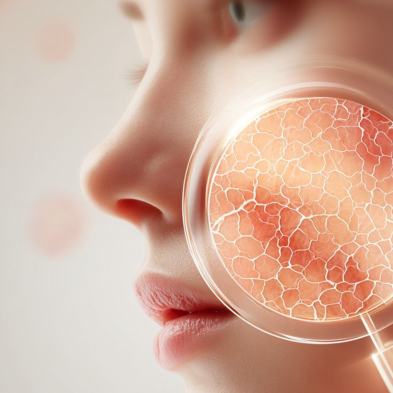






- The skin’s protective barrier and its importance for facial health
- How to recognise a breach in the skin’s protective barrier
- How to recognise a breach in the skin’s protective barrier
- The main causes of damage to the skin barrier
- Products and ingredients for restoring the skin barrier
- What to temporarily avoid using if you have sensitive skin
- How to establish a daily skincare routine to support the skin’s barrier
The skin’s protective barrier is the foundation of its healthy condition. When it functions properly, the skin retains moisture more effectively, reacts less to external factors and tolerates daily skincare more comfortably. When the skin’s barrier is damaged, dryness and irritation set in, along with increased sensitivity, flaking, a stinging sensation and the feeling that the skin has become ‘fussy’.
Find out all about the fragrance pyramid and choose not based on first impressions, but on the scent that will stay with you throughout the day!
Today, we’ll look at how to tell if your skin barrier is damaged, why this happens, and how to choose skincare products for sensitive facial skin without making the situation worse. We’ll also discuss which products help restore the skin’s protective barrier, which ingredients to look for in formulations, and what’s best to temporarily exclude from your routine.
The skin’s protective barrier and its role in facial health
.png "the skin’s protective barrier")
To choose the right skincare routine, it is important first to understand exactly what we are restoring. The skin’s protective barrier can be thought of as a thin but very important ‘safety system’ on the surface of the face. It helps to retain moisture within the skin and reduces the impact of external irritants: wind, cold, sun, pollution, harsh cleansing and active cosmetic ingredients.
When the skin’s barrier is healthy, the complexion looks smoother, calmer and more hydrated. The skin does not react to every touch, does not flush for no reason and does not require constant application of cream. But if the protective layer is weakened, moisture evaporates more quickly and irritants are more likely to cause discomfort. This leads to a feeling of tightness, flaking, redness and increased sensitivity.
It is important to understand that sensitive skin is not always a distinct skin type. Sometimes sensitive facial skin is a temporary condition that occurs following:
- harsh skincare
- frequent use of skincare products
- over-drying or improper cleansing
In other words, even those who have previously used acids, retinoids or mattifying products without any problems may find their skin becoming sensitive.
Damage to the skin barrier can manifest in various ways. Dry and sensitive skin is more likely to feel tight and flaky. Oily skin may appear shiny, become inflamed and show signs of irritation. Skin affected by rosacea or prone to redness often becomes even more reactive if not cared for properly.
A healthy skin barrier is not just a single step in your skincare routine, but the foundation upon which the overall condition of your face depends. If the barrier is compromised, even high-quality products may be less effective or cause discomfort.
How can you tell if your skin’s protective barrier is compromised
A compromised skin barrier rarely goes unnoticed. Usually, the skin starts to react differently: products that used to suit you may suddenly cause a stinging sensation, redness or discomfort. So the first step is not to buy new products, but to carefully assess the signals your skin is sending you.
One of the most common signs is a tight feeling after washing your face. If, a few minutes after cleansing, you feel an urgent need to apply cream and your skin feels as though it’s ‘tight’, this may indicate that your cleanser is too harsh or that your skin’s barrier has already been weakened.
Another important symptom is dry, irritated skin. The face may flake, itch, become red, or feel rougher to the touch. Sometimes there are areas where make-up doesn’t sit well: foundation emphasises the texture, rolls off, or looks patchy.
If your skin starts to sting when using your usual cream, serum or even water, this is also a warning sign. This can be a sign of hypersensitive skin, especially if you have recently used acids, retinoids, peels, scrubs or acne treatments as part of your skincare routine. Hypersensitive facial skin often reacts not only to cosmetics, but also to the cold, wind, hot water, the sun or make-up.
It is worth paying particular attention to redness. If your skin is prone to rosacea or you have sensitive skin with rosacea, damage to the skin barrier can exacerbate reactions to temperature changes, active ingredients and physical irritation. In this condition, the face reddens more quickly, and a sensation of heat or burning may occur more frequently.
The main signs that the skin’s protective barrier has been compromised:
- tightness after washing, even if the product feels gentle;
- flaking and a feeling of dryness throughout the day;
- a burning or stinging sensation after applying your usual skincare products;
- redness, itching, a sensation of heat;
- increased sensitivity to cold, wind, sun or water;
- deterioration in skin texture and uneven application of make-up;
- a feeling that the skin has become very sensitive and cannot tolerate almost anything.
If you notice several of these signs at once, your skin probably doesn’t need more active ingredients, but rather to restore its barrier function. At this stage, it’s important to switch to a gentler, more supportive skincare routine.
Why does the skin barrier become damaged
.png "the skin’s protective barrier has been compromised")
The skin’s barrier rarely becomes damaged for no reason. More often than not, it is the result of several factors that gradually build up. We may not notice the problem straight away, because for a while the skin ‘puts up with’ harsh skincare routines, frequent experiments or a lack of hydration. But at some point, its resilience runs out, and sensitivity sets in.
- One of the most common causes is over-exfoliation. Lathering until the skin squeaks, frequent use of cleansing brushes, harsh gels, alcohol-based toners and the habit of washing your face with hot water can weaken the skin’s protective barrier. Oily, sensitive skin requires particular care: the desire to remove shine often leads to over-drying, and in response, the skin may produce even more sebum whilst remaining dehydrated.
- The second common cause is an excess of active ingredients. Acids, retinoids, spot treatments and brightening serums can be beneficial, but only when used correctly. If you use several active ingredients at the same time, exfoliate too often or fail to include a restorative step, your skin may become irritated and reactive. This is often how sensitive, acne-prone skin develops: the inflammation remains, but is accompanied by dryness, a stinging sensation and flaking.
- Insufficient hydration also affects the condition of the skin barrier. It is sometimes thought that oily skin does not need cream, whilst dry skin simply requires any rich moisturiser. In reality, moisturising sensitive skin requires a thoughtful approach: it is important not only to provide moisture, but also to help the skin retain it. Therefore, dry and sensitive skin often needs not only moisturising ingredients, but also lipids, ceramides and richer textures.
- Weather conditions can also exacerbate the problem. Cold, wind, dry indoor air, strong sunlight and sudden changes in temperature have a particularly noticeable effect on sensitive skin prone to redness. If the skin’s barrier is already weakened, external factors are more likely to cause irritation.
- Finally, your skin’s condition may deteriorate if you keep changing your skincare routine. When you’re trying out a new gel, serum, cream and mask all at once, it’s hard to tell exactly which product isn’t working for you. For sensitive skin, your skincare routine should be consistent: it’s best to introduce new products gradually and monitor your skin’s reaction.
A compromised skin barrier is usually not caused by a single ‘bad’ product, but by overloading the skin. Therefore, the first step towards recovery is not to complicate your skincare routine, but to simplify it.
Products to restore the skin barrier and beneficial ingredients
.png "sensitive skin care")
When your skin is irritated, it’s important not just to choose ‘anything moisturising’, but products that help restore comfort and support the skin’s protective functions. A comprehensive approach helps to restore the skin’s protective barrier: gentle cleansing, moisturising, lipid support, sun protection, and avoiding harsh formulas whilst the skin is recovering.
- Stage one – cleansing. For sensitive facial skin, it is best to choose gentle gels, creamy cleansers, cleansing milks or mild foams that do not leave the skin feeling tight. If you wear make-up or use SPF, you may need a separate make-up removal step. Micellar water for sensitive skin can be a good option, but it is best to rinse it off with water or a gentle cleanser, especially if your skin is prone to irritation.
- The second step is moisturisers. Serums and essences containing glycerine, hyaluronic acid, betaine, aloe vera or other moisturising ingredients help to reduce the feeling of dryness. But it is important to remember that if the skin’s barrier is damaged, a light serum alone may not be enough. A cream is often needed on top of the moisturiser to help lock in moisture and reduce discomfort.
- Stage three — restoration of the lipid layer. Products containing ceramides, squalane, oils in a suitable concentration, cholesterol and fatty acids are particularly beneficial here. These are precisely the ingredients people often look for when they need a cream to restore the skin’s barrier. But it doesn’t have to be just a cream: emulsions, balms, restorative serums and soothing masks also help to support the barrier.
- Panthenol - one of the most popular ingredients for sensitive skin care. It helps to soothe irritation and supports the skin’s natural healing process. However, if your skin is very sensitive, it is best to introduce any active ingredients gradually.
- SPF - a key point to remember. When the skin’s barrier is compromised, the sun can exacerbate dryness, irritation and redness. For sensitive skin, it is best to choose gentle sunscreens that do not sting the eyes, do not cause a burning sensation and are suitable for daily use. This is particularly important if you have sensitive skin with rosacea or skin prone to redness.
For skin barrier repair to be effective, skincare products must follow the same principle: gently cleansing, moisturising, locking in moisture, soothing and protecting. The simpler and more straightforward your routine, the greater the chance of restoring your skin’s comfort without causing unnecessary stress.
What to temporarily avoid when caring for sensitive skin

When the skin is already irritated, even beneficial ingredients can feel too harsh. That’s why, during the recovery period, it’s important not only to introduce the right products but also to remove anything that prevents the skin barrier from returning to normal. This doesn’t mean you have to give up acids, retinoids or anti-acne products for good. But the skin needs time to regain its resilience.
- First and foremost, you should stop using scrubs for the time being.
- It’s also best to take a break from acids and exfoliants. If your skin’s protective barrier is compromised, AHA, BHA and PHA acids can cause a stinging sensation, flaking and increased dryness.
- Retinoids are another active ingredient that requires a cautious approach. They can be part of an effective skincare routine, but if the skin barrier is compromised, they often exacerbate dryness and irritation. If your skin has become hypersensitive, it is best to restore its comfort first, and only then consider reintroducing retinol.
- Alcohol-based toners, drying lotions and harsh spot treatments can be particularly damaging if you have sensitive, problem skin. It often seems that acne needs to be ‘dried out’, but over-drying can only exacerbate irritation. The result is a typical scenario: sensitive, oily skin that is shiny, inflamed, flaky and does not respond well to skincare.
- You should also avoid warming masks, harsh cleansing brushes, frequent use of clay masks, and washing your face with hot water. All of these can exacerbate redness and a burning sensation, especially if your skin is prone to redness or has already become very sensitive.
During your recovery, it is best to stick to a minimalist routine:
- gentle cleansing;
- moisturising;
- barrier-supporting product;
- SPF in the morning.
The fewer irritants there are, the quicker your skin will be able to return to a calm state.
How to establish a skincare routine that supports the skin’s barrier every day
Damage to the skin’s protective barrier isn’t a death sentence, nor is it a reason to give up on skincare altogether. It’s a sign that your skin needs more gentleness and less harsh treatment. When you stop using irritating products, opt for gentle cleansing, add moisturisers for sensitive skin, restorative ingredients and daily SPF, your face will gradually become calmer, smoother and more comfortable.
The key is to choose skincare products not only based on your skin type, but also on its current condition. Dry and sensitive skin, oily sensitive skin, sensitive skin with acne, or skin prone to rosacea require different textures, but the basic principle is the same: to restore the skin’s protective barrier, maintain it every day, and not interfere with the skin’s natural functions.